
TFTC #60 Inside Samson Rope
Sherrilltree Mar 31st 2026We spent time at Samson Rope’s facility in Washington to see how their climbing and rigging lines are made, and what actually affects how a rope behaves once it’s in use.
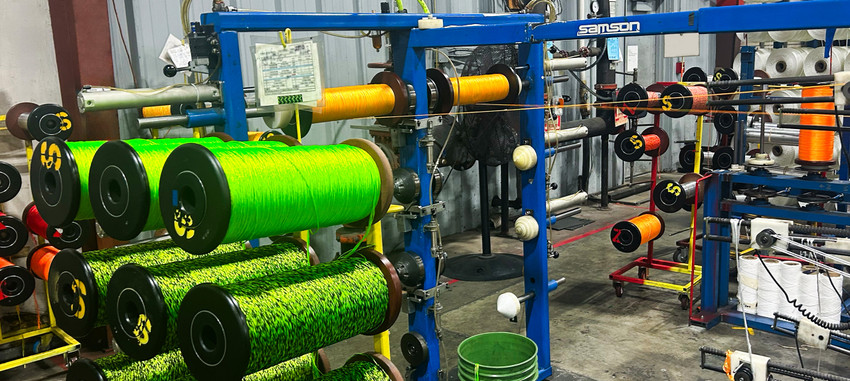
Being on-site gave us access to the full process, from the people designing the rope to the crews running the braiders and handling final inspection. From raw fiber through finished line, everything is handled in-house. On the production floor, you can follow the rope step by step, how it’s braided, how tension is managed, and how each line is checked before it leaves.
Those details show up later in ways you can feel on the job.
What Happens Before the Rope Gets to You
Rope construction isn’t just about strength ratings. It’s about how the line handles once it’s loaded, run through hardware, and used day after day.
A few things stood out while walking the floor:
Braid structure
How the jacket and core are built affects how the rope holds its shape. A tighter, more uniform braid tends to stay round under load and run more consistently through devices.
Tension during manufacturing
Tension control during braiding plays a role in how much a rope will “settle” over time. Lines built with consistent tension tend to feel more stable earlier in their lifespan, instead of changing character after a few climbs.
Quality checks throughout the process
Instead of relying on a single final inspection, there are checks at multiple stages. That consistency helps prevent sections of rope from behaving differently over time.
It also became clear how many people are involved in getting a rope from raw fiber to finished line. Engineering, testing, and production all overlap, and each step affects how the rope handles once it’s in a system.
How That Shows Up in the Tree
These aren’t small details once the rope is in use.
They affect things like:
• How the rope feeds through a device on ascent
• How it grabs or releases in a hitch or mechanical
• How much it flattens or stays round under load
• How it wears after repeated cycles
A line that’s built consistently tends to behave the same way from one job to the next. It doesn’t suddenly feel different halfway through its life.
The People Behind It
We spent time with the teams responsible for the process:
• Rope design engineers
• QA and testing teams
• Production crews running the braiders
• Warehouse staff handling finished lines
• Leadership overseeing development and consistency
The thing that stood out to us, many of the people we met have been there a long time. That kind of tenure shows up in how consistent the process is and how repeatable the end product feels.
Our time spent walking through how Samson operates as a whole, gave a lot of context to how design decisions carry through to production.
Working Perspective in the Field
We also worked alongside arborist Aidon Pyne during the visit.
Aidon brought a working perspective into what we were seeing, not just how the rope is built, but how it performs once it’s in a system. His background in arboriculture, along with his experience in search-and-rescue, shapes how he evaluates rope: how it handles, how consistent it feels, and how it responds under load.
That connection between design and real use helps bridge the gap between what happens in manufacturing and what actually matters in the tree.
We also worked alongside arborist Aidon Pyne during the visit.
Aidon brought a working perspective into what we were seeing, not just how the rope is built, but how it performs once it’s in a system. His background in arboriculture, along with his experience in search-and-rescue, shapes how he evaluates rope: how it handles, how consistent it feels, and how it responds under load.
That connection between design and real use helps bridge the gap between what happens in manufacturing and what actually matters in the tree.
What Stood Out
Rope construction isn’t abstract when you see it up close.
The differences show up in:
• How clean the rope runs through hardware
• How predictable it feels under load
• How it responds after repeated use
• How much adjustment is needed as it breaks in
If you’ve ever had a line that felt different week to week, a lot of that traces back to how it was built.
Why It Matters
The more consistent the rope, the more predictable your system becomes.
That affects:
• Movement efficiency during ascent
• Control when descending or positioning
• Wear on both the rope and your hardware
• How much you have to adjust your setup over time
When you understand how a rope is built — and why it behaves the way it does — it’s easier to match it to the kind of work you’re doing.
Closing
Seeing how rope is built puts context behind how it performs.
The way a line is braided, how tension is managed, and how it’s checked throughout the process all carry through to what you feel in the tree, how it feeds, how it holds shape, and how it wears over time.
There’s a lot behind a rope before it ever gets put into service.
Understanding that makes it easier to choose the right line and knowing what to expect from it once it’s in your system.