
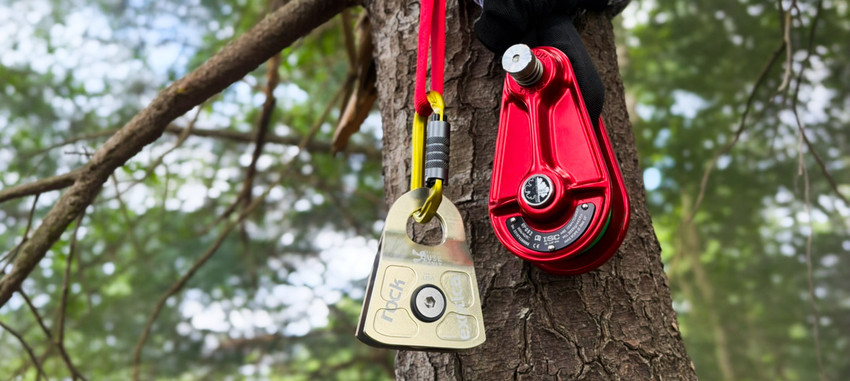
TFTC #63 Pulleys vs. Rigging Blocks: Understanding the Difference
Sherrilltree Sep 11th 2026At a glance, a pulley and a rigging block can have similarities.
Both use a sheave to redirect rope. Both reduce friction compared to running rope directly over a branch. Both are commonly found in arborist gear bags.
But despite their similarities, pulleys and rigging blocks are designed for very different jobs.
Understanding where each belongs in a system can help prevent equipment damage and, more importantly, help keep a rigging system operating within its intended limits.
What Is a Pulley?
A pulley is designed to redirect rope and create mechanical advantage in climbing, hauling, lifting, and positioning systems. You'll commonly find pulleys used for:
• Climbing systems
• Mechanical advantage systems
• Speedlines
• Light-duty rigging applications
• Redirects where loads remain relatively controlled
Most arborist pulleys are designed around predictable loads. They perform extremely well when managing rope movement and reducing friction, but they are not intended to absorb the shock associated with heavy negative rigging.
In other words, pulleys are generally designed for loads that are applied gradually rather than loads that are dropped into the system.
A pulley is designed to redirect rope and create mechanical advantage in climbing, hauling, lifting, and positioning systems. You'll commonly find pulleys used for:
• Climbing systems
• Mechanical advantage systems
• Speedlines
• Light-duty rigging applications
• Redirects where loads remain relatively controlled
Most arborist pulleys are designed around predictable loads. They perform extremely well when managing rope movement and reducing friction, but they are not intended to absorb the shock associated with heavy negative rigging.
In other words, pulleys are generally designed for loads that are applied gradually rather than loads that are dropped into the system.
What Is a Rigging Block?
Rigging blocks are designed for the forces commonly encountered in negative rigging. In a negative rigging setup, the piece being cut is above the rigging point and is allowed to fall before the rope begins controlling the load. That short fall can generate forces far greater than the weight of the piece itself. Rigging blocks are built with these applications in mind, while most pulleys are intended for rope redirection, mechanical advantage systems, and other applications that do not involve repeatedly catching falling wood.
Common characteristics include:
• Larger sheaves
• Heavier side plates
• More robust bearings or bushings
• Higher working load limits
• Greater ability to withstand repeated dynamic loading
Rigging blocks are designed for the forces commonly encountered in negative rigging. In a negative rigging setup, the piece being cut is above the rigging point and is allowed to fall before the rope begins controlling the load. That short fall can generate forces far greater than the weight of the piece itself. Rigging blocks are built with these applications in mind, while most pulleys are intended for rope redirection, mechanical advantage systems, and other applications that do not involve repeatedly catching falling wood.
Common characteristics include:
• Larger sheaves
• Heavier side plates
• More robust bearings or bushings
• Higher working load limits
• Greater ability to withstand repeated dynamic loading
While no rigging system should be intentionally shock loaded, rigging blocks are built for the realities of tree work where loads are regularly caught and lowered.
Negative Rigging Changes Everything
This is where the distinction becomes important.
When lowering a branch or section of stem, the rope often goes slack before becoming loaded. Once the rope comes tight, forces increase rapidly throughout the system.
That sudden loading is very different from the forces seen in climbing systems, hauling systems, or static redirects.
A pulley that performs perfectly in a mechanical advantage system may not be appropriate for catching repeated rigging loads.
Always follow the manufacturer's intended use and loading recommendations.
Why Textile Slings Matter
One of the most common mistakes is attaching a pulley directly to a textile sling. Many pulleys have narrow side plates and attachment points designed around carabiners, shackles, or other hardware.
When loaded against a textile sling, the edges of the pulley can concentrate force into a very small area of the sling. This concentrated loading can damage the fibers and, in some cases, create cutting or abrasion hazards.
Rigging blocks are often designed with attachment points intended for use with ultra slings, dead-eye slings, whoopie slings, and other arborist rigging slings.
Again, the manufacturer's instructions should always determine what attachment methods are approved.
Choosing the Right Tool
A simple way to think about it is:
Pulley
• Redirecting rope
• Mechanical advantage
• Climbing systems
• Controlled loads
• Hauling and positioning
rigging block
• Lowering wood
• Negative rigging
• Dynamic loading
• Repeated catches
• Heavy rigging applications
Pulley
• Redirecting rope
• Mechanical advantage
• Climbing systems
• Controlled loads
• Hauling and positioning
rigging block
• Lowering wood
• Negative rigging
• Dynamic loading
• Repeated catches
• Heavy rigging applications
Both have an important place in arboriculture, but they are not interchangeable.
The best choice is not the strongest-looking piece of equipment. It's the one designed for the forces and application you expect it to see.